One plan instead of five channels
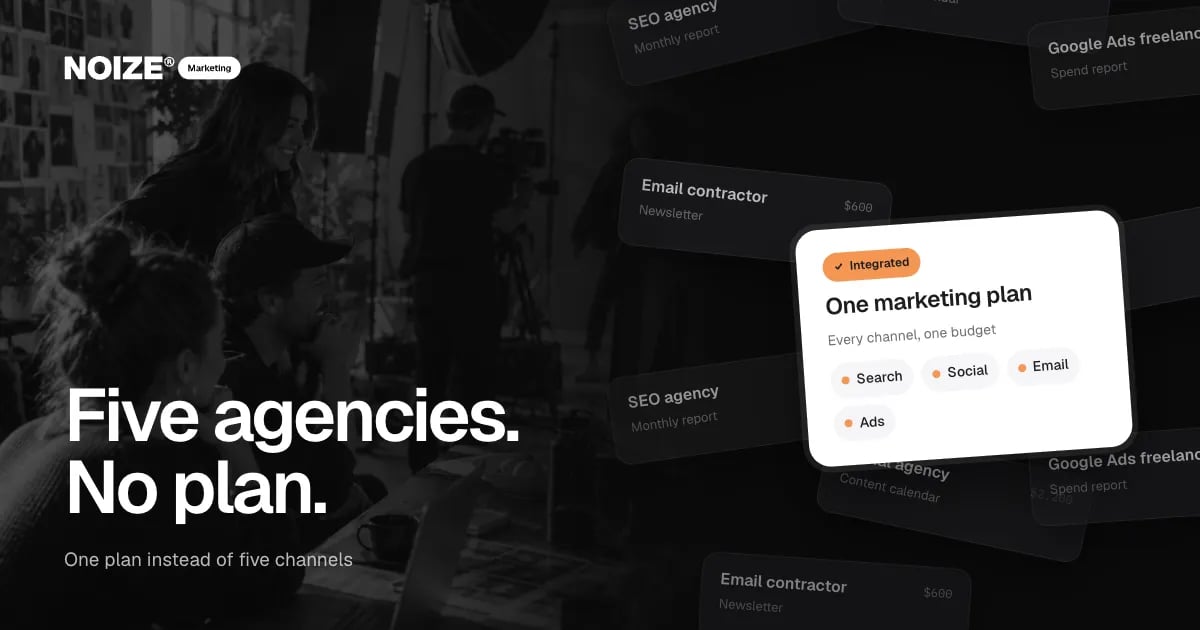
An SEO agency sends a monthly report. A social agency sends a content calendar. A Google Ads freelancer sends a spend summary. An email contractor sends the newsletter stats. A video studio sends a quote. Five suppliers, five reports, five sets of priorities. And no plan connecting any of them.
Five channels, five agencies, no plan. It is how many businesses end up running their marketing, one channel at a time, each added to solve a problem. The result is a lot of activity and very little coordination.
The short version
- Channels work better together.
- Search captures demand that social and video create.
- Email nurtures people who aren't ready yet.
- Retargeting brings back visitors who left.
- When every channel runs from one plan, with one budget and one set of measures, each supports the others and the business can see what is actually working.
- That means fewer suppliers, clearer results and better use of every marketing dollar.
What goes wrong with separate channels
01Each channel optimises for itself
The SEO agency wants rankings. The social agency wants engagement. The ads freelancer wants a low cost per click. Each can hit its target while the business misses its own.
02Messages don't match
The ads promise one thing, the social posts talk about another and the emails push a third. Customers who see all three get a confused picture of the business.
03Budgets are set by habit
Each supplier's budget tends to stay the same or grow, regardless of results, because nobody compares channels side by side.
04Nobody owns the customer journey
Customers don't experience channels separately. They see a post, search the name, click an ad, read an email and then buy. When each step is managed by a different supplier, nobody manages the journey.
05Reporting doesn't add up
Each supplier claims credit for the same customer. Add up their reported results and the total is often more than the sales the business actually made.
> I've worked with multibillion-dollar clients and small businesses, and the integrated campaigns always won. Not because any single channel was brilliant, but because every channel was pulling in the same direction at the same time. The compounding effect is hard to get any other way.
How an integrated plan works
- One goal. The plan starts with a business outcome: qualified enquiries, sales or customers in a defined segment.
- One audience. Every channel speaks to the same best-fit customer.
- One message. The core offer and story are consistent everywhere, adapted to each format.
- Defined roles. Each channel has a job. Social and video create interest. Search captures it. Email nurtures it. Retargeting recovers it.
- One budget. Money is allocated across channels based on results and moved when the evidence changes.
- One report. Results are measured from first touch to sale, so every channel is judged on its contribution to customers.
“We've had nothing but compliments and praise since making the change.”
An illustrative example
Imagine a fitness brand using four separate suppliers. Each reports success, yet memberships are flat. An integrated plan aligns them: social and video build awareness of one clear offer, search ads capture people looking for gyms nearby, a landing page converts visitors into trial bookings and email follows up with trial members. Budget moves from the channels producing engagement to the ones producing members. The total spend barely changes. Memberships grow because the channels finally work as a sequence.
What changes when you consolidate
Owners usually notice three things. First, time: one plan, one meeting, one report instead of five. Second, clarity: they can finally see which channels produce customers. Third, results: the same budget performs better because the channels support each other instead of competing for credit.
Where Marketing fits in the business
NOIZE Marketing runs paid media, search, social, email, content and analytics as one plan. It works from the brand NOIZE Creative builds, sends traffic to pages NOIZE Digital creates and hands leads to NOIZE Sales for follow-up. That is integration beyond the marketing channels themselves: the whole path from attention to revenue planned together.
Questions to ask before consolidating
- Which channels produce customers today, and at what cost?
- Which suppliers report on business outcomes rather than channel metrics?
- Where do messages conflict across channels?
- Who owns the customer journey from first touch to sale?
- What would you do with the time saved by managing one plan instead of five?
The answers usually make the case clearly.
Mistakes to avoid when consolidating
Moving every channel at once can disrupt campaigns that are working. Transition in stages, starting with tracking and strategy, then moving channels across one at a time.
Don't lose historical data. Make sure ad accounts, analytics and email lists are owned by the business and transferred properly, so past performance informs the new plan.
And don't assume one plan means one channel. Integration isn't about cutting channels for the sake of it. It is about giving each one a clear job and measuring it fairly. Some channels will grow, some will shrink and a few may stop, all based on evidence.
Where to start this week
Gather the last report from every marketing supplier. Put them side by side and add up the customers each claims. Compare the total with your actual new customers. The gap shows how much of your marketing is being double counted, and how much clarity an integrated plan could bring. See marketing.noize.com.au.
Related reading
- Attention is easy. Growth is harder: measuring the marketing that matters
- Reach buyers, not bystanders: getting paid ads in front of the right people
Common questions
What is integrated marketing?
Running all marketing channels as one coordinated plan with a shared goal, audience, message, budget and set of measures.
Is integrated marketing more expensive?
Usually not. Consolidating often reduces management overhead and wasted spend, and improves results from the same budget.
Can we keep our in-house social media person?
Yes. Integrated planning can include in-house team members, with NOIZE handling strategy and specialist channels.
How do you decide the budget for each channel?
Based on each channel's role and its measured contribution to qualified enquiries and customers, reviewed regularly.
How quickly can we move to one plan?
Most businesses can transition over one or two months, starting with tracking and strategy and moving channels across in stages.
Do I need a marketing strategy before running ads?
Yes. A clear strategy ensures ads target the right audience with the right offer and are measured properly.
What does each channel do in an integrated plan?
Typically social and video build awareness and interest, search captures people actively looking, email nurtures people who aren't ready yet and retargeting brings back recent visitors. The exact mix depends on the business.
How do we know if our current agencies are working together?
Ask whether they share one goal, one report and one view of the customer journey. If each reports separately on its own metrics, they probably aren't.
Can integrated marketing work for a small budget?
Yes. With a smaller budget it matters even more that each channel has a clear role and that money goes where it produces customers.
Your first strategy conversation is on us.
Have a chatThe brand for business.